
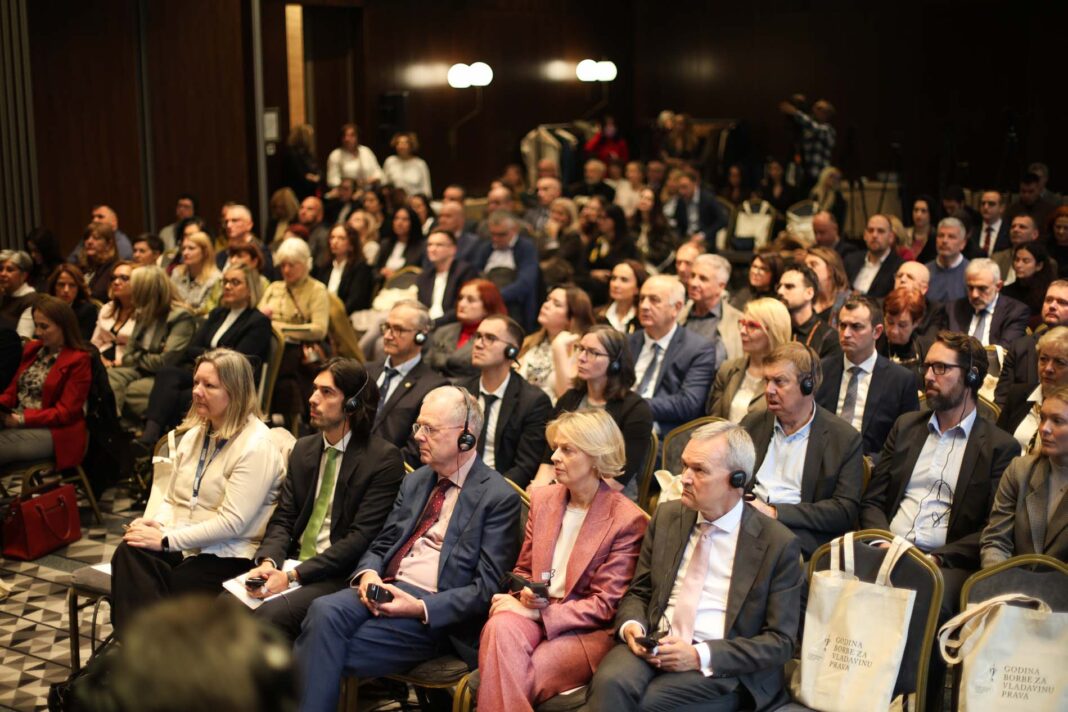
Specialization of prosecutors, a multidisciplinary approach and international cooperation are necessary for the efficient prosecution of environmental crimes, while civil society organizations can significantly contribute to the detection and proof of the crimes with their expertise and information from the field.
These topics were discussed on the second day of the international conference “Improving of Environmental Crime Prosecution: Cooperation, Expertise and Best Practices in Europe”, organized by the Prosecutors Association of Serbia in cooperation with the European Network of Prosecutors for the Environment (ENPE).
Role of ENPE, Eurojust and Europol network in prosecutorial investigations of environmental crime
The fourth panel, dedicated to processing cases of environmental pollution and cooperation with ENPE, was moderated by Livija Panić Miletić, Chief Public Prosecutor of the Basic Public Prosecutor’s Office in Subotica and member of the PAS. She announced the imminent publication of the guidelines for prosecuting environmental crime, which she prepared with her colleague Jelena Samuilov as part of our project “Greening Justice: Legal Protection of the Environment”.
Dr. Christos Naintos, Public Prosecutor from Greece and permanent representative of Greek full member of ENPE, presented the case of the tanker “Agia Zoni II”, which sank in the Saronic Gulf in 2017 and caused a major oil pollution of the sea. The case opened up the issue of distinguishing an accident from an intentional act: the first-instance verdict from May 2025 found that environmental crime was committed with intent, in order to achieve financial benefit.
Dr. Đurđica Đorđević, Public Prosecutor of the Basic Public Prosecutor’s Office in Vranje, who researches and covers this area in professional publications, spoke about cross-border cooperation.
She pointed out the importance of PAS cooperation with ENPE network, as well as the support mechanisms that prosecutors can get through Eurojust and Europol. She mentioned investigation teams, which enable coordinated collection of evidence in several countries and Europol’s SIENA application for secure exchange of operational data.
According to the data she presented, during 2024 and 2025, Serbia participated in about 60 cases of cross-border cooperation with European countries.
Prof. Dr. Remus Jurj from the Maritime University in Constanca in Romania, who has many years of experience in theoretical analysis and practical application of criminal legal protection of the environment also participated in the work of the panel.
How environmental activists help in the investigation and prosecution of cases?
The final panel “The role of civil society in creating an enabling environment” was moderated by Jelena Samuilov, Public Prosecutor of the Basic Public Prosecutor’s Office in Pancevo and member of the PAS Management Board.
She pointed out that environmental protection is a public interest and the civil society organizations should be seen as partners in achieving a common task. Their presence in the field and the information they have are especially valuable in the early stages of detecting crimes, with the need to teach activists how to report crimes and preserve relevant evidence.
Katerina Weissova, Prosecutor from the Czech Republic and member of the ENPE Management Board, presented examples of cooperation with organizations dealing with the protection of wild animals. Animal tracking data, volunteers’ work and specially trained dogs to find poison baits and dead animals can be an important support to investigations.
Dr. Katarina Golubović, President of the Committee of Lawyers for Human Rights – JUKOM, explained that this organization entered the field of environmental protection by providing legal assistance to environmental activists. From that experience, activities were developed to connect activists and prosecutors, training on filing criminal charges and gathering evidence, as well as cooperation through local councils in ten cities and municipalities. She also pointed out the need to improve the procedural position of organizations that protect the environment.
Milan Ružić, executive director of the Society for the Protection of Birds, presented the experience of this organization in reporting crimes and cooperation with the police and prosecutors. Using the example of poisoning of wild animals, he showed how complex the procedure can be due to the large number of competent institutions and problems in obtaining toxicological findings. He warned that without proper analysis, key evidence for prosecution is missing, while toxic baits that remain in nature continue to endanger animals and people.
Brankica Janković, President of the Center for Equality and Security, spoke about environmental justice and unequal consequences of pollution. Particularly affected are poor citizens, elderly women in rural areas, people with disabilities and residents of infrastructurally neglected settlements, who have fewer opportunities to provide clean water, pay for analyzes or legal assistance and move from threatened areas. She emphasized the responsibility of institutions to protect the most vulnerable, as well as the role of the media in ensuring that environmental problems receive the attention they deserve.
The discussion also opened up the question of what happens to dangerous substances after the discovery of a criminal offense. As Jelena Samuilov pointed out, punishment is only one part of the answer: if hazardous waste remains where it was found, the environment is not protected and the goal of the action is not fully achieved.
Jelena Samuilov also spoke to RTS television about the problems when prosecutors dealing with these cases.
Source: UTS, RTS